

 N THE early days of the siege of
the fort of Tabarsi, Vahid was engaged in spreading the teachings of
the Cause in Burujird as well as in the province
of Kurdistan. He had resolved to win the majority
of the inhabitants of those regions to the Faith of the
Bab, and had intended to proceed from thence to Fars and
there continue his labours. As soon as he had learned of
Mulla Husayn's departure for Mazindaran, he hastened to
the capital and undertook the necessary preparations for
his journey to the fort of Tabarsi. He was preparing to leave,
when Baha'u'llah arrived from Mazindaran and informed
him of the impossibility of joining his brethren. He was
greatly saddened at this news, and his only consolation in
those days was to visit Baha'u'llah frequently, and to obtain
the benefit of His wise and priceless counsels.(1)
Vahid eventually determined to proceed to Qazvin and
to resume the work in which he had been engaged. From
thence he left for Qum and Kashan, where he met his fellow-disciples
and was able to stimulate their enthusiasm and
reinforce their efforts. He continued his journey to Isfahan,
to Ardistan and Ardikan, and in each of these cities he proclaimed,
with zest and fearlessness, the fundamental teachings
of his Master and succeeded in winning over a considerable
He arrived at Yazd on the first day of the month of
Jamadiyu'l-Avval, in the year 1266 A.H.,(1) the fifth day of
which, the anniversary of the Bab's Declaration, coincided
Vahid seized the occasion to proclaim, fearlessly and
without reserve, in that gathering, the basic principles of
his Faith, and to demonstrate their validity. The majority
of those who heard him were but partially acquainted with
the distinguishing features of the Cause, and were ignorant
of its full import. Certain ones among them were irresistibly
attracted, and readily embraced it; the rest, unable to challenge
its claims publicly, denounced it in their hearts and
swore to extirpate it by every means in their power. His
eloquence and fearless exposition of the Truth inflamed their
hostility and strengthened their determination to seek, without
delay, the overthrow of his influence. That very day
witnessed the combination of their forces against him, and
marked the beginning of an episode that was destined to
bring in its wake so much suffering and distress.(1)
To destroy the life of Vahid became the paramount object
of their activity. They spread the news that, on the day
of Naw-Ruz, in the midst of the assembled dignitaries of the
city, both civil and ecclesiastical, Siyyid Yahyay-i-Darabi
had had the temerity to unveil the challenging features of
the Faith of the Bab and had adduced, for the purpose of his
argument, proofs and evidences gleaned both from the Qur'an
and from the traditions of Islam. "Though his listeners,"
they urged, "ranked among the most illustrious of the mujtahids
of the city, no one could be found in that assemblage
to venture a protest against his vehement assertions of the
This report spread like wildfire throughout Yazd and the
surrounding district. It kindled, on the one hand, the flame
of bitter hatred, and, on the other, was instrumental in adding
considerable numbers to those who had already identified
themselves with that Faith. From Ardikan and Manshad,
as well as from the more distant towns and villages, crowds
of people, eager to hear of the new Message, flocked to the
house of Vahid. "What are we to do?" they asked him.
"In what manner do you advise us to show forth the sincerity
of our faith and the intensity of our devotion?" From
morning till night, Vahid was absorbed in resolving their
perplexities and in directing their steps in the path of service.
For forty days, this feverish activity persisted on the
part of his zealous supporters, both men and women. His
house had become the rallying centre of an innumerable host
of devotees who yearned to demonstrate worthily the spirit
of the Faith that had fired their souls. The commotion that
ensued provided the Navvab-i-Radavi with a fresh pretext
for enlisting the support of the governor of the city,(1) who
was young and inexperienced in the affairs of State, in his
efforts against his adversary. He soon fell a victim to the
intrigues and machinations of that evil plotter, who succeeded
in inducing him to despatch a force of armed men
to besiege the house of Vahid. While a regiment of the army
was proceeding to that spot, a mob composed of the degraded
elements of the city were, at the instigation of the Navvab,
directing their steps towards that same place, determined
by their threats and imprecations to intimidate its occupants.
Though hemmed in by hostile forces on every side, Vahid
continued, from the window of the upper floor of his house, to
animate the zeal of his supporters and to clarify whatever
remained obscure in their minds. At the sight of a whole
regiment, reinforced by an infuriated mob, preparing to attack
Seeing the agitation that had seized his friends, he exhorted
them to be calm and patient, and to rest assured
that the omnipotent Avenger would ere long inflict, with
His own invisible hand, a crushing defeat upon the forces
arrayed against His loved ones. No sooner had he uttered
these words than the news arrived that a certain Muhammad-Abdu'llah,
whom no one suspected of being still alive, had
suddenly emerged with a number of his comrades, who had
N THE early days of the siege of
the fort of Tabarsi, Vahid was engaged in spreading the teachings of
the Cause in Burujird as well as in the province
of Kurdistan. He had resolved to win the majority
of the inhabitants of those regions to the Faith of the
Bab, and had intended to proceed from thence to Fars and
there continue his labours. As soon as he had learned of
Mulla Husayn's departure for Mazindaran, he hastened to
the capital and undertook the necessary preparations for
his journey to the fort of Tabarsi. He was preparing to leave,
when Baha'u'llah arrived from Mazindaran and informed
him of the impossibility of joining his brethren. He was
greatly saddened at this news, and his only consolation in
those days was to visit Baha'u'llah frequently, and to obtain
the benefit of His wise and priceless counsels.(1)
Vahid eventually determined to proceed to Qazvin and
to resume the work in which he had been engaged. From
thence he left for Qum and Kashan, where he met his fellow-disciples
and was able to stimulate their enthusiasm and
reinforce their efforts. He continued his journey to Isfahan,
to Ardistan and Ardikan, and in each of these cities he proclaimed,
with zest and fearlessness, the fundamental teachings
of his Master and succeeded in winning over a considerable
He arrived at Yazd on the first day of the month of
Jamadiyu'l-Avval, in the year 1266 A.H.,(1) the fifth day of
which, the anniversary of the Bab's Declaration, coincided
Vahid seized the occasion to proclaim, fearlessly and
without reserve, in that gathering, the basic principles of
his Faith, and to demonstrate their validity. The majority
of those who heard him were but partially acquainted with
the distinguishing features of the Cause, and were ignorant
of its full import. Certain ones among them were irresistibly
attracted, and readily embraced it; the rest, unable to challenge
its claims publicly, denounced it in their hearts and
swore to extirpate it by every means in their power. His
eloquence and fearless exposition of the Truth inflamed their
hostility and strengthened their determination to seek, without
delay, the overthrow of his influence. That very day
witnessed the combination of their forces against him, and
marked the beginning of an episode that was destined to
bring in its wake so much suffering and distress.(1)
To destroy the life of Vahid became the paramount object
of their activity. They spread the news that, on the day
of Naw-Ruz, in the midst of the assembled dignitaries of the
city, both civil and ecclesiastical, Siyyid Yahyay-i-Darabi
had had the temerity to unveil the challenging features of
the Faith of the Bab and had adduced, for the purpose of his
argument, proofs and evidences gleaned both from the Qur'an
and from the traditions of Islam. "Though his listeners,"
they urged, "ranked among the most illustrious of the mujtahids
of the city, no one could be found in that assemblage
to venture a protest against his vehement assertions of the
This report spread like wildfire throughout Yazd and the
surrounding district. It kindled, on the one hand, the flame
of bitter hatred, and, on the other, was instrumental in adding
considerable numbers to those who had already identified
themselves with that Faith. From Ardikan and Manshad,
as well as from the more distant towns and villages, crowds
of people, eager to hear of the new Message, flocked to the
house of Vahid. "What are we to do?" they asked him.
"In what manner do you advise us to show forth the sincerity
of our faith and the intensity of our devotion?" From
morning till night, Vahid was absorbed in resolving their
perplexities and in directing their steps in the path of service.
For forty days, this feverish activity persisted on the
part of his zealous supporters, both men and women. His
house had become the rallying centre of an innumerable host
of devotees who yearned to demonstrate worthily the spirit
of the Faith that had fired their souls. The commotion that
ensued provided the Navvab-i-Radavi with a fresh pretext
for enlisting the support of the governor of the city,(1) who
was young and inexperienced in the affairs of State, in his
efforts against his adversary. He soon fell a victim to the
intrigues and machinations of that evil plotter, who succeeded
in inducing him to despatch a force of armed men
to besiege the house of Vahid. While a regiment of the army
was proceeding to that spot, a mob composed of the degraded
elements of the city were, at the instigation of the Navvab,
directing their steps towards that same place, determined
by their threats and imprecations to intimidate its occupants.
Though hemmed in by hostile forces on every side, Vahid
continued, from the window of the upper floor of his house, to
animate the zeal of his supporters and to clarify whatever
remained obscure in their minds. At the sight of a whole
regiment, reinforced by an infuriated mob, preparing to attack
Seeing the agitation that had seized his friends, he exhorted
them to be calm and patient, and to rest assured
that the omnipotent Avenger would ere long inflict, with
His own invisible hand, a crushing defeat upon the forces
arrayed against His loved ones. No sooner had he uttered
these words than the news arrived that a certain Muhammad-Abdu'llah,
whom no one suspected of being still alive, had
suddenly emerged with a number of his comrades, who had
 That night, Muhammad-'Abdu'llah asked to be introduced
into the presence of Vahid. He assured him of his
Muhammad-'Abdu'llah, however, preferred to ignore the
advice of Vahid. "It would be cowardly of me," he was
heard to remark as he retired, "to abandon my friends to
the mercy of an irate and murderous adversary. What,
then, would be the difference between me and those who
forsook the Siyyidu'sh-Shuhada(1) on the day of Ashura,(2)
and left him companionless on the field of Karbila? A merciful
God will, I trust, be indulgent towards me and will forgive
my action."
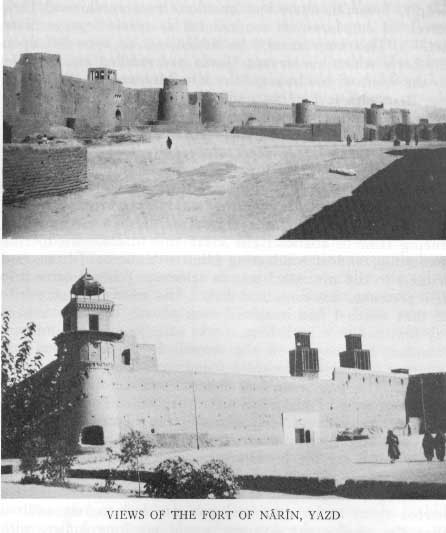
With these words, he directed his steps to the fort of Narin
and compelled the forces that had massed in its vicinity to
seek an inglorious refuge within the walls of the fort; and
succeeded in keeping the governor confined along with those
who were besieged. He himself kept watch, ready to intercept
whatever reinforcements might seek to reach them.
Meanwhile the Navvab had succeeded in raising a general
upheaval in which the mass of the inhabitants took part.
They were preparing to attack the house of Vahid when he
summoned Siyyid Abdu'l-'Azim-i-Khu'i, surnamed the
Siyyid-i-Khal-Dar, who had participated for a few days in the
defence of the fort of Tabarsi, and whose dignity of bearing
attracted widespread attention, and bade him mount his
own steed and address publicly, through the streets and
The Siyyid-i-Khal-Dar leaped upon the steed and, escorted
by four of his chosen brethren, rode out through the
market and pealed out, in accents of compelling majesty,
the warning he had been commissioned to proclaim. Not
content with the message with which he had been entrusted,
he ventured to add, in his own inimitable manner, a few
words by which he sought to heighten the effect which the
proclamation had produced. "Beware," he thundered, "if
you despise our plea. My lifted voice, I warn you, will prove
sufficient to cause the very walls of your fort to tremble, and
the strength of my arm will be capable of breaking down the
resistance of its gates!"
His stentorian voice rang out like a trumpet, and diffused
consternation in the hearts of those who heard it. With one
voice, the affrighted population declared their intention to
lay down their swords and cease to molest Vahid, whose
lineage they said they would henceforth recognise and respect.
Constrained by the blank refusal of the people to fight
against Vahid, the Navvab induced them to direct their
attack against Muhammad-'Abdu'llah and his comrades,
who were stationed in the neighbourhood of the fort. The
clash of these forces induced the governor to sally from his
refuge and to instruct the besieged detachment to join hands
with those who had been recruited by the Navvab. Muhammad-'Abdu'llah
had begun to disperse the mob that had
rushed forth from the city against him, when he was suddenly
assailed by the fire which the troops opened upon him
by order of the governor. A bullet struck his foot and threw
him to the ground. A number of his supporters were also
The enemy followed him to that house, fully determined
to seize and slay him. The clamour of the people that had
massed around his house compelled Vahid to order Mulla
Muhammad-Riday-i-Manshadi, one of the most enlightened
ulamas of Manshad, who had discarded his turban and
offered himself as his doorkeeper, to sally forth and, with the
aid of six companions, whom he would choose, to scatter their
forces. "Let each one of you raise his voice," he commanded
them, "and repeat seven times the words `Allah-u-Akbar,'(1)
and on your seventh invocation spring forward at one and
the same moment into the midst of your assailants."
Mulla Muhammad-Rida, whom Baha'u'llah had named
Rada'r-Ruh, sprang to his feet and, with his companions,
straightway proceeded to fulfil the instructions he had received.
Those who accompanied him, though frail of form
and inexperienced in the art of swordsmanship, were fired
with a faith that made them the terror of their adversaries.
Seven of the most redoubtable among the enemy perished
that day, which was the twenty-seventh of the month of
Jamadiyu'th-Thani.(2) "No sooner had we routed the enemy,"
Mulla Muhammad-Rida related, "and returned to the house
of Vahid, than we found Muhammad-'Abdu'llah lying
wounded before us. He was carried to our leader, and partook
of the food with which the latter had been served.
Afterwards he was borne to a hiding place, where he remained
concealed until he recovered from his wound. Eventually
he was seized and slain by the enemy."
That very night, Vahid bade his companions disperse
and exercise the utmost vigilance to secure their safety. He
advised his wife to remove, with her children and all their
belongings, to the home of her father, and to leave behind
whatever was his personal property. "This palatial residence,"
he informed her, "I have built with the sole intention
that it should be eventually demolished in the path of the
Cause, and the stately furnishings with which I have adorned
it have been purchased in the hope that one day I shall be
In the mid-watches of that same night, Vahid arose and,
collecting the writings of the Bab that were in his possession,
as well as the copies of all the treatises that he himself had
composed, entrusted them to his servant Hasan, and ordered
him to convey them to a place outside the gate of the city
where the road branches off to Mihriz. He bade him await
his arrival, and warned him that, were he to disregard his
instructions, he would never again be able to meet him.
No sooner had Hasan mounted his horse and prepared
to leave than the cries of the sentinels, who kept watch at
the entrance of the fort, reached his ears. Fearing lest they
should capture him and seize the precious manuscripts in
his possession, he decided to follow a different route from the
one which his master had instructed him to take. As he
was passing behind the fort, the sentinels recognised him,
shot his horse, and captured him.
Meanwhile Vahid was preparing to depart from Yazd.
Leaving his two sons, Siyyid Isma'il and Siyyid Ali-Muhammad,
in the care of their mother, he left, accompanied by his
two other sons, Siyyid Ahmad and Siyyid Mihdi, together
with two of his companions who were both residents of Yazd
and had asked permission to accompany him on his journey.
The first, who was named Ghulam-Rida, was a man of exceptional
courage, while the latter, Ghulam-Riday-i-Kuchik,
had distinguished himself in the art of marksmanship. He
chose the same route that he had advised his servant to take,
and, arriving safely at that spot, was surprised to find that
Hasan was missing. Vahid knew immediately that he had
disregarded his directions and had been captured by the
The departure of Vahid from Yazd roused the enemy to
fresh exertions. They rushed to his house, plundered his
possessions, and demolished it completely.(2) He himself was
meanwhile directing his steps towards Nayriz. Though unaccustomed
to walking, he covered, that night, seven farsangs(3)
on foot, while his sons were carried part of the way
by his two companions. In the course of the ensuing day,
he concealed himself within the recesses of a neighbouring
mountain. As soon as his brother, who resided in that
vicinity and entertained a deep affection for him, was informed
of his arrival, he secretly despatched to him whatever
provisions he required. That same day a body of the governor's
mounted attendants, who had set out in pursuit of
Vahid, arrived at that village, searched the house of his
brother, where they suspected that he was concealed, and
appropriated a large amount of his property. Unable to
find him, they retraced their steps to Yazd.
Vahid, in the meantime, made his way through the
mountains until he reached the district of Bavanat-i-Fars.
Most of its inhabitants, who were numbered among his fervent
admirers, readily embraced the Cause, among whom was the
All along his route, wherever he tarried, Vahid's first
thought, as soon as he had dismounted, was to seek the neighbouring
masjid, wherein he would summon the people to hear
him announce the tidings of the New Day. Utterly oblivious
of the fatigues of his journey, he would promptly ascend the
pulpit and fearlessly proclaim to his congregation the character
of the Faith he had risen to champion he would spend
only one night in that place if he had succeeded in winning
to the Cause souls upon whom he could rely to propagate it
after his departure. Otherwise he would straightway resume
his march and refuse further to associate with them. "Through
whichever village I pass," he often remarked, "and fail to
inhale from its inhabitants the fragrance of belief, its food
and its drink are both distasteful to me."
Arriving at the village of Runiz, in the district of Fasa,
Vahid decided to tarry for a few days. Those hearts which
he found receptive to his call he strove to attract and to inflame
with the fire of God's love. As soon as the news of his
arrival reached Nayriz, the entire population of the Chinar-Sukhtih
quarter hastened out to meet him. People from
other quarters likewise, impelled by their love and admiration
for him, decided to join them. Fearing lest Zaynu'l-'Abidin
Khan, the governor of Nayriz, should object to their visit,
the majority of them set out at night. From the quarter of
Chinar-Sukhtih alone more than a hundred students, preceded
by their leader, Haji Shaykh Abdu'l-Ali, the father-in-law
of Vahid, and a judge of recognised standing throughout
that district, were moved to join a number of the most
distinguished among the notables of Nayriz in greeting the
expected visitor ere his arrival at their town. Among these
figured Mulla Abdu'l-Husayn, a venerable man of eighty
who was highly esteemed for his piety and learning; Mulla
Baqir, who was the Imam of the Chinar-Sukhtih quarter;
Mirza Husayn-i-Qutb, the kad-khuda'(1) of the Bazar
quarter, All of these, some by day and others by night, went as
far as the village of Runiz in order to extend their welcome to
the visitor, and to assure him of their unalterable devotion.
Although the Bab had revealed a general Tablet addressed
specially to those who had newly embraced His Cause in
Nayriz, yet its recipients remained ignorant of its significance
and fundamental principles. It was given to Vahid to enlighten
them regarding its true purpose and set forth its
distinguishing features.
No sooner had Zaynu'l-'Abidin Khan been made aware
of the considerable exodus that had taken place for the
purpose of welcoming the arrival of Vahid, than he despatched
a special messenger to overtake and inform those who had
already departed of his determination to take the life, capture
the wives, and confiscate the property of everyone who
persisted in giving allegiance to him. Not one of those who
departed heeded the warning, but rather did they cling still
more passionately to their leader. Their unyielding determination
and disdainful neglect of his messenger filled the
governor with dismay. Fearful lest these should arise against
him, he decided to transfer his residence to the village of
Qutrih, where his original home had been, and which lay at
a distance of eight farsangs(2) from Nayriz. He chose that
Vahid had meanwhile left Runiz for the shrine of Pir-Murad,
which was situated outside the village of Istahbanat.
Despite the interdiction pronounced by the ulamas of that
village against his admittance, no less than twenty of its inhabitants
went out to welcome him, and accompanied him
as far as Nayriz. When they arrived, in the forenoon of
That night, Muhammad-'Abdu'llah asked to be introduced
into the presence of Vahid. He assured him of his
Muhammad-'Abdu'llah, however, preferred to ignore the
advice of Vahid. "It would be cowardly of me," he was
heard to remark as he retired, "to abandon my friends to
the mercy of an irate and murderous adversary. What,
then, would be the difference between me and those who
forsook the Siyyidu'sh-Shuhada(1) on the day of Ashura,(2)
and left him companionless on the field of Karbila? A merciful
God will, I trust, be indulgent towards me and will forgive
my action."
With these words, he directed his steps to the fort of Narin
and compelled the forces that had massed in its vicinity to
seek an inglorious refuge within the walls of the fort; and
succeeded in keeping the governor confined along with those
who were besieged. He himself kept watch, ready to intercept
whatever reinforcements might seek to reach them.
Meanwhile the Navvab had succeeded in raising a general
upheaval in which the mass of the inhabitants took part.
They were preparing to attack the house of Vahid when he
summoned Siyyid Abdu'l-'Azim-i-Khu'i, surnamed the
Siyyid-i-Khal-Dar, who had participated for a few days in the
defence of the fort of Tabarsi, and whose dignity of bearing
attracted widespread attention, and bade him mount his
own steed and address publicly, through the streets and
The Siyyid-i-Khal-Dar leaped upon the steed and, escorted
by four of his chosen brethren, rode out through the
market and pealed out, in accents of compelling majesty,
the warning he had been commissioned to proclaim. Not
content with the message with which he had been entrusted,
he ventured to add, in his own inimitable manner, a few
words by which he sought to heighten the effect which the
proclamation had produced. "Beware," he thundered, "if
you despise our plea. My lifted voice, I warn you, will prove
sufficient to cause the very walls of your fort to tremble, and
the strength of my arm will be capable of breaking down the
resistance of its gates!"
His stentorian voice rang out like a trumpet, and diffused
consternation in the hearts of those who heard it. With one
voice, the affrighted population declared their intention to
lay down their swords and cease to molest Vahid, whose
lineage they said they would henceforth recognise and respect.
Constrained by the blank refusal of the people to fight
against Vahid, the Navvab induced them to direct their
attack against Muhammad-'Abdu'llah and his comrades,
who were stationed in the neighbourhood of the fort. The
clash of these forces induced the governor to sally from his
refuge and to instruct the besieged detachment to join hands
with those who had been recruited by the Navvab. Muhammad-'Abdu'llah
had begun to disperse the mob that had
rushed forth from the city against him, when he was suddenly
assailed by the fire which the troops opened upon him
by order of the governor. A bullet struck his foot and threw
him to the ground. A number of his supporters were also
The enemy followed him to that house, fully determined
to seize and slay him. The clamour of the people that had
massed around his house compelled Vahid to order Mulla
Muhammad-Riday-i-Manshadi, one of the most enlightened
ulamas of Manshad, who had discarded his turban and
offered himself as his doorkeeper, to sally forth and, with the
aid of six companions, whom he would choose, to scatter their
forces. "Let each one of you raise his voice," he commanded
them, "and repeat seven times the words `Allah-u-Akbar,'(1)
and on your seventh invocation spring forward at one and
the same moment into the midst of your assailants."
Mulla Muhammad-Rida, whom Baha'u'llah had named
Rada'r-Ruh, sprang to his feet and, with his companions,
straightway proceeded to fulfil the instructions he had received.
Those who accompanied him, though frail of form
and inexperienced in the art of swordsmanship, were fired
with a faith that made them the terror of their adversaries.
Seven of the most redoubtable among the enemy perished
that day, which was the twenty-seventh of the month of
Jamadiyu'th-Thani.(2) "No sooner had we routed the enemy,"
Mulla Muhammad-Rida related, "and returned to the house
of Vahid, than we found Muhammad-'Abdu'llah lying
wounded before us. He was carried to our leader, and partook
of the food with which the latter had been served.
Afterwards he was borne to a hiding place, where he remained
concealed until he recovered from his wound. Eventually
he was seized and slain by the enemy."
That very night, Vahid bade his companions disperse
and exercise the utmost vigilance to secure their safety. He
advised his wife to remove, with her children and all their
belongings, to the home of her father, and to leave behind
whatever was his personal property. "This palatial residence,"
he informed her, "I have built with the sole intention
that it should be eventually demolished in the path of the
Cause, and the stately furnishings with which I have adorned
it have been purchased in the hope that one day I shall be
In the mid-watches of that same night, Vahid arose and,
collecting the writings of the Bab that were in his possession,
as well as the copies of all the treatises that he himself had
composed, entrusted them to his servant Hasan, and ordered
him to convey them to a place outside the gate of the city
where the road branches off to Mihriz. He bade him await
his arrival, and warned him that, were he to disregard his
instructions, he would never again be able to meet him.
No sooner had Hasan mounted his horse and prepared
to leave than the cries of the sentinels, who kept watch at
the entrance of the fort, reached his ears. Fearing lest they
should capture him and seize the precious manuscripts in
his possession, he decided to follow a different route from the
one which his master had instructed him to take. As he
was passing behind the fort, the sentinels recognised him,
shot his horse, and captured him.
Meanwhile Vahid was preparing to depart from Yazd.
Leaving his two sons, Siyyid Isma'il and Siyyid Ali-Muhammad,
in the care of their mother, he left, accompanied by his
two other sons, Siyyid Ahmad and Siyyid Mihdi, together
with two of his companions who were both residents of Yazd
and had asked permission to accompany him on his journey.
The first, who was named Ghulam-Rida, was a man of exceptional
courage, while the latter, Ghulam-Riday-i-Kuchik,
had distinguished himself in the art of marksmanship. He
chose the same route that he had advised his servant to take,
and, arriving safely at that spot, was surprised to find that
Hasan was missing. Vahid knew immediately that he had
disregarded his directions and had been captured by the
The departure of Vahid from Yazd roused the enemy to
fresh exertions. They rushed to his house, plundered his
possessions, and demolished it completely.(2) He himself was
meanwhile directing his steps towards Nayriz. Though unaccustomed
to walking, he covered, that night, seven farsangs(3)
on foot, while his sons were carried part of the way
by his two companions. In the course of the ensuing day,
he concealed himself within the recesses of a neighbouring
mountain. As soon as his brother, who resided in that
vicinity and entertained a deep affection for him, was informed
of his arrival, he secretly despatched to him whatever
provisions he required. That same day a body of the governor's
mounted attendants, who had set out in pursuit of
Vahid, arrived at that village, searched the house of his
brother, where they suspected that he was concealed, and
appropriated a large amount of his property. Unable to
find him, they retraced their steps to Yazd.
Vahid, in the meantime, made his way through the
mountains until he reached the district of Bavanat-i-Fars.
Most of its inhabitants, who were numbered among his fervent
admirers, readily embraced the Cause, among whom was the
All along his route, wherever he tarried, Vahid's first
thought, as soon as he had dismounted, was to seek the neighbouring
masjid, wherein he would summon the people to hear
him announce the tidings of the New Day. Utterly oblivious
of the fatigues of his journey, he would promptly ascend the
pulpit and fearlessly proclaim to his congregation the character
of the Faith he had risen to champion he would spend
only one night in that place if he had succeeded in winning
to the Cause souls upon whom he could rely to propagate it
after his departure. Otherwise he would straightway resume
his march and refuse further to associate with them. "Through
whichever village I pass," he often remarked, "and fail to
inhale from its inhabitants the fragrance of belief, its food
and its drink are both distasteful to me."
Arriving at the village of Runiz, in the district of Fasa,
Vahid decided to tarry for a few days. Those hearts which
he found receptive to his call he strove to attract and to inflame
with the fire of God's love. As soon as the news of his
arrival reached Nayriz, the entire population of the Chinar-Sukhtih
quarter hastened out to meet him. People from
other quarters likewise, impelled by their love and admiration
for him, decided to join them. Fearing lest Zaynu'l-'Abidin
Khan, the governor of Nayriz, should object to their visit,
the majority of them set out at night. From the quarter of
Chinar-Sukhtih alone more than a hundred students, preceded
by their leader, Haji Shaykh Abdu'l-Ali, the father-in-law
of Vahid, and a judge of recognised standing throughout
that district, were moved to join a number of the most
distinguished among the notables of Nayriz in greeting the
expected visitor ere his arrival at their town. Among these
figured Mulla Abdu'l-Husayn, a venerable man of eighty
who was highly esteemed for his piety and learning; Mulla
Baqir, who was the Imam of the Chinar-Sukhtih quarter;
Mirza Husayn-i-Qutb, the kad-khuda'(1) of the Bazar
quarter, All of these, some by day and others by night, went as
far as the village of Runiz in order to extend their welcome to
the visitor, and to assure him of their unalterable devotion.
Although the Bab had revealed a general Tablet addressed
specially to those who had newly embraced His Cause in
Nayriz, yet its recipients remained ignorant of its significance
and fundamental principles. It was given to Vahid to enlighten
them regarding its true purpose and set forth its
distinguishing features.
No sooner had Zaynu'l-'Abidin Khan been made aware
of the considerable exodus that had taken place for the
purpose of welcoming the arrival of Vahid, than he despatched
a special messenger to overtake and inform those who had
already departed of his determination to take the life, capture
the wives, and confiscate the property of everyone who
persisted in giving allegiance to him. Not one of those who
departed heeded the warning, but rather did they cling still
more passionately to their leader. Their unyielding determination
and disdainful neglect of his messenger filled the
governor with dismay. Fearful lest these should arise against
him, he decided to transfer his residence to the village of
Qutrih, where his original home had been, and which lay at
a distance of eight farsangs(2) from Nayriz. He chose that
Vahid had meanwhile left Runiz for the shrine of Pir-Murad,
which was situated outside the village of Istahbanat.
Despite the interdiction pronounced by the ulamas of that
village against his admittance, no less than twenty of its inhabitants
went out to welcome him, and accompanied him
as far as Nayriz. When they arrived, in the forenoon of


 from Shiraz and destroy your
homes and subject you to untold
indignities." "We are
ready and resigned to the will
of God," answered, with one
voice, the congregation. "God
grant us His grace to withstand
the calamities that may
yet befall us. We cannot,
however, reconcile ourselves
to so abrupt and hasty a separation
from you."
No sooner had these words
escaped their lips than men
and women joined hands in
conducting Vahid triumphantly
to his home. Wild
with excitement and exultant
with joy, they pressed round
him and, with cheers and acclamations,
escorted him to
the very entrance of his house.
The few days Vahid consented to tarry in Nayriz were
spent mostly in the masjid, where he continued with his customary
The fascination which he exerted over the people could
not fail to fan to fury the dormant hostility of Zaynu'l-'Abidin
Khan. He was roused to new exertions, and gave
orders that an army be raised for the avowed purpose of
eradicating a Cause which he felt was fast undermining his
own position. He soon succeeded in recruiting about a thousand
men, consisting of both cavalry and infantry, all of whom
were well trained in the art of warfare and were equipped
with an ample store of munitions. His plan was, by a sudden
onset, to make him a prisoner.
Vahid, as soon as he was informed of the designs of the
governor, ordered those twenty companions who had left
Istahbanat to welcome him, and who had accompanied him
as far as Nayriz, to occupy the fort of Khajih, which was
situated in the vicinity of the Chinar-Sukhtih quarter. He
appointed Shaykh Hadi, son of Shaykh Muhsin, as the leader
of the band, and urged his followers who resided in that quarter
to fortify the gates, the turrets, and the walls of that
stronghold.
The governor had meanwhile transferred his seat to his
own house in the Bazar quarter. The force he had raised
accompanied him and occupied the fort situated in its vicinity.
Its towers and walls, which he began to reinforce, overlooked
the whole town. Having compelled Siyyid Abu-Talib, the
kad-khuda(1) of that quarter and one of the companions of
Vahid, to evacuate his house, he fortified its roof and, stationing
upon it a number of his men, under the command of
Muhammad-'Ali Khan, he gave orders to open fire upon his
adversary. The first to suffer was that same Mulla Abdu'l-Husayn
who, despite his advanced age, had walked out to
welcome Vahid. He was offering his prayer on the roof of
his house when a bullet struck his right foot, causing him to
bleed profusely. That cruel blow evoked the sympathy of
Vahid, who hastened, in a written message to the sufferer,
The suddenness of the attack dismayed a number of the
companions who had hastily embraced the Message and had
failed to appreciate its full meaning. Their faith was so severely
shaken that a few were induced, in the dead of night,
to separate themselves from their companions and join forces
with the enemy. Vahid had no sooner been informed of
their action than he arose at the hour of dawn and, mounting
his steed and accompanied by a number of his supporters,
rode out to the fort of Khajih, where he fixed his residence.
His arrival was the signal for a fresh attack upon him.
Zaynu'l-'Abidin Khan immediately despatched his elder
brother, Ali-Asghar Khan, together with a thousand men,
all armed and well trained, to lay siege to that fort, in which
seventy-two companions had already taken shelter. At the
hour of sunrise, a certain number of them, acting in accordance
with the instructions or Vahid, sallied forth, and with
extraordinary rapidity forced the besiegers to disperse.
No more than three of the companions met their death
in the course of that encounter. The first was Taju'd-Din,
a man renowned for his fearlessness, whose business was the
manufacture of the woollen kulah;(1)
the second was Zaynil,
son of Iskandar, who was an agriculturist by profession; the
third was Mirza Abu'l-Qasim, who was a man of distinguished
merit.
This complete and sudden rout aroused the apprehensions
of Prince Firuz Mirza, the Nusratu'd-Dawlih, governor of
Shiraz, who gave orders for the prompt extermination of the
occupants of the fort. Zaynu'l-'Abidin Khan despatched
one of the prince's attendants to Vahid, urging him, in view
of the strained relations between them, to depart from Nayriz,
in the hope that the mischief that had been kindled might
soon be extinguished. "Tell him," replied Vahid, "that my
two children, together with their two attendants, are all the
company I have with me. If my presence in this town will
cause mischief, I am willing to depart why is it that, instead
Finding that Zaynu'l-'Abidin Khan ignored his warning,
Vahid ordered his companions to emerge from the fort and
punish their assailants. With admirable courage and confidence,
they succeeded, though extremely young in years,
and utterly inexperienced in the use of arms, in demoralising
a trained and organised army. Ali-Asghar Khan himself
perished, and two of his sons were captured. Zaynu'l-'Abidin
Khan disgracefully retreated, with what still remained of his
scattered forces, to the village of Qutrih, acquainted the prince
with the gravity of the situation, and begged him to send
immediate reinforcements, stressing in particular the need
for heavy artillery and a large detachment of both infantry
and cavalry.
Vahid, on his part, finding that the enemy was bent on
their extermination, gave orders that the defences of the
fort be strengthened, that a water-cistern be constructed
within its enclosure, and that the tents they had carried away
be pitched outside its gates. That day certain of his companions
had assigned to them special functions and duties.
Karbila'i Mirza Muhammad was made the gatekeeper of
the fort; Shaykh Yusuf, the custodian of the funds; Karbila'i
Muhammad, son of Shamsu'd-Din, the superintendent of
the gardens adjoining the fort and its barricades; Mirza
Ahmad, the uncle of Aliy-i-Sardar, was appointed the officer
in charge of the tower of the mill known by the name of
Chinar, situated in the vicinity of the fort; Shaykhi-i-Shivih-Kash
to be the executioner; Mirza Muhammad-Ja'far,
cousin of Zaynu'l-'Abidin Khan, the chronicler;
Mirza Fadlu'llah as the reader of these records; Mashhadi
Taqi-Baqqal to be the gaoler; Muhammad Taqi, the
registrar; and Ghulam-Riday-i-Yazdi to be the captain of
the forces. In addition to the seventy-two companions who
were with him within the fort and had accompanied him
Zaynu'l-'Abidin Khan again renewed his appeal to the
prince, and enclosed this time with his petition, which pleaded
for urgent and adequate reinforcements, the sum of five
thousand tumans(1) as his personal gift to him. He entrusted
his letter to one of his intimate friends, Mulla Baqir, allowed
him to mount his own steed, and instructed him to deliver
it in person to the prince. He chose him for his intrepidity,
his fluency of speech, and tactfulness. Mulla Baqir took an
unfrequented route, and after a day's journey reached a
place called Hudashtak, in the neighbourhood of which was
a fort around which tribes who roved the country sometimes
pitched their tents.
Mulla Baqir dismounted near one of these tents, and whilst
he was talking with its occupants, Haji Siyyid Isma'il, the
Shaykhu'l-Islam of Bavanat, arrived. He had obtained
leave from Vahid to proceed to his native village on some
urgent affair, and to return immediately to Nayriz. After
his lunch, he saw that a richly caparisoned horse was tethered
to the ropes of one of the neighbouring tents. Being informed
that it belonged to one of the friends of Zaynu'l-'Abidin
Khan, who had arrived from Nayriz and was on his
way to Shiraz, Haji Siyyid Isma'il, who was a man of exceptional
courage, immediately went to that tent, mounted
the horse, and, unsheathing his sword, sternly spoke these
words to the owner of the tent with whom Mulla Baqir was
still conversing: "Arrest this scoundrel, who has fled from
before the face of the Sahibu'z-Zaman.(2) Tie his hands and
deliver him to me." Affrighted by the words and manner of
Haji Mulla Isma'il, the occupants of the tent immediately
obeyed. They bound his hands and delivered the rope with
which they had tied him to Haji Siyyid Isma'il, who spurred
on his charger in the direction of Nayriz and compelled his
captive to follow him. At a distance of two farsangs from that
town, he reached the village of Rastaq and delivered his
Zaynu'l-'Abidin Khan, far from relaxing in his determination
to solicit the aid he needed from Shiraz, appealed this time
with increased vehemence to the prince, begging him
to redouble his efforts for the extermination of what he regarded
as the gravest menace to the security of his province.
Not content with his earnest entreaty, he despatched to
Shiraz a number of his trusted men, whom he loaded with
presents for the prince, hoping thereby to induce him to act
with promptness. In a further effort to ensure the success
of his endeavours, he addressed several appeals to the leading
ulamas and siyyids of Shiraz, wherein he glaringly misrepresented
the aims of Vahid, expatiated upon his subversive
activities, and urged them to intercede with the prince and
entreat him to expedite the despatch of reinforcements.
The prince readily granted their request. He instructed
Abdu'llah Khan, the Shuja'u'l-Mulk, to set out at once for
Nayriz, accompanied by the Hamadani and Silakhuri regiments,
headed by several officers, and provided with an
adequate force of artillery. He, moreover, instructed his
representative in Nayriz to recruit all the able-bodied men
from the surrounding district, including the villages of Istahbanat,
Iraj, Panj-Ma'adin, Qutrih, Bashnih, Dih-Chah,
Mushkan, and Rastaq. To these he added the members of
the tribe known by the name of Visbaklariyyih, whom he
commanded to join the army of Zaynu'l-'Abidin Khan.
An innumerable host suddenly surrounded the fort in
which Vahid and his companions were besieged, and began
to dig trenches around it and to set up barricades along those
trenches.(1) No sooner was the work accomplished than they
The second night, however, Vahid summoned Ghulam-Riday-i-Yazdi
and instructed him, together with fourteen of
his companions, to sally forth from the fort and drive off the
enemy. Those who were called upon to perform that task
were for the most part men of advanced age, whom no one
would have thought capable of bearing the brunt of so fierce
a struggle. Among them was a shoemaker who, though
more than ninety years of age, showed such enthusiasm and
vigour as no youth could hope to exceed. The rest of the
fourteen were mere lads, as yet wholly unprepared to face the
perils and endure the strain which such a sally entailed. Age,
however, to those heroes, whom a dauntless will and an immovable
confidence in the high destiny of their Cause had
wholly transformed, mattered but little. They were instructed
by their leader to divide immediately after they
left the cover of the fort and, raising simultaneously the cry
of "Allah-u-Akbar!"(1) to spring into the midst of the enemy.
No sooner had the signal been given than they arose
and, hurrying to their steeds and rifles, marched out of the
gate of the fort. Undaunted by the fire which spouted from
the mouths of the cannons and by the bullets which rained
upon their heads, they plunged headlong into the midst of
their adversaries. This sudden encounter lasted for no less
than eight hours, during which that fearless band was able
to demonstrate such skill and bravery as amazed the veterans
in the ranks of the enemy. From the town of Nayriz, as well
as from its surrounding fortifications reinforcements rushed
to the aid of the small company that had withstood so valiantly
from Shiraz and destroy your
homes and subject you to untold
indignities." "We are
ready and resigned to the will
of God," answered, with one
voice, the congregation. "God
grant us His grace to withstand
the calamities that may
yet befall us. We cannot,
however, reconcile ourselves
to so abrupt and hasty a separation
from you."
No sooner had these words
escaped their lips than men
and women joined hands in
conducting Vahid triumphantly
to his home. Wild
with excitement and exultant
with joy, they pressed round
him and, with cheers and acclamations,
escorted him to
the very entrance of his house.
The few days Vahid consented to tarry in Nayriz were
spent mostly in the masjid, where he continued with his customary
The fascination which he exerted over the people could
not fail to fan to fury the dormant hostility of Zaynu'l-'Abidin
Khan. He was roused to new exertions, and gave
orders that an army be raised for the avowed purpose of
eradicating a Cause which he felt was fast undermining his
own position. He soon succeeded in recruiting about a thousand
men, consisting of both cavalry and infantry, all of whom
were well trained in the art of warfare and were equipped
with an ample store of munitions. His plan was, by a sudden
onset, to make him a prisoner.
Vahid, as soon as he was informed of the designs of the
governor, ordered those twenty companions who had left
Istahbanat to welcome him, and who had accompanied him
as far as Nayriz, to occupy the fort of Khajih, which was
situated in the vicinity of the Chinar-Sukhtih quarter. He
appointed Shaykh Hadi, son of Shaykh Muhsin, as the leader
of the band, and urged his followers who resided in that quarter
to fortify the gates, the turrets, and the walls of that
stronghold.
The governor had meanwhile transferred his seat to his
own house in the Bazar quarter. The force he had raised
accompanied him and occupied the fort situated in its vicinity.
Its towers and walls, which he began to reinforce, overlooked
the whole town. Having compelled Siyyid Abu-Talib, the
kad-khuda(1) of that quarter and one of the companions of
Vahid, to evacuate his house, he fortified its roof and, stationing
upon it a number of his men, under the command of
Muhammad-'Ali Khan, he gave orders to open fire upon his
adversary. The first to suffer was that same Mulla Abdu'l-Husayn
who, despite his advanced age, had walked out to
welcome Vahid. He was offering his prayer on the roof of
his house when a bullet struck his right foot, causing him to
bleed profusely. That cruel blow evoked the sympathy of
Vahid, who hastened, in a written message to the sufferer,
The suddenness of the attack dismayed a number of the
companions who had hastily embraced the Message and had
failed to appreciate its full meaning. Their faith was so severely
shaken that a few were induced, in the dead of night,
to separate themselves from their companions and join forces
with the enemy. Vahid had no sooner been informed of
their action than he arose at the hour of dawn and, mounting
his steed and accompanied by a number of his supporters,
rode out to the fort of Khajih, where he fixed his residence.
His arrival was the signal for a fresh attack upon him.
Zaynu'l-'Abidin Khan immediately despatched his elder
brother, Ali-Asghar Khan, together with a thousand men,
all armed and well trained, to lay siege to that fort, in which
seventy-two companions had already taken shelter. At the
hour of sunrise, a certain number of them, acting in accordance
with the instructions or Vahid, sallied forth, and with
extraordinary rapidity forced the besiegers to disperse.
No more than three of the companions met their death
in the course of that encounter. The first was Taju'd-Din,
a man renowned for his fearlessness, whose business was the
manufacture of the woollen kulah;(1)
the second was Zaynil,
son of Iskandar, who was an agriculturist by profession; the
third was Mirza Abu'l-Qasim, who was a man of distinguished
merit.
This complete and sudden rout aroused the apprehensions
of Prince Firuz Mirza, the Nusratu'd-Dawlih, governor of
Shiraz, who gave orders for the prompt extermination of the
occupants of the fort. Zaynu'l-'Abidin Khan despatched
one of the prince's attendants to Vahid, urging him, in view
of the strained relations between them, to depart from Nayriz,
in the hope that the mischief that had been kindled might
soon be extinguished. "Tell him," replied Vahid, "that my
two children, together with their two attendants, are all the
company I have with me. If my presence in this town will
cause mischief, I am willing to depart why is it that, instead
Finding that Zaynu'l-'Abidin Khan ignored his warning,
Vahid ordered his companions to emerge from the fort and
punish their assailants. With admirable courage and confidence,
they succeeded, though extremely young in years,
and utterly inexperienced in the use of arms, in demoralising
a trained and organised army. Ali-Asghar Khan himself
perished, and two of his sons were captured. Zaynu'l-'Abidin
Khan disgracefully retreated, with what still remained of his
scattered forces, to the village of Qutrih, acquainted the prince
with the gravity of the situation, and begged him to send
immediate reinforcements, stressing in particular the need
for heavy artillery and a large detachment of both infantry
and cavalry.
Vahid, on his part, finding that the enemy was bent on
their extermination, gave orders that the defences of the
fort be strengthened, that a water-cistern be constructed
within its enclosure, and that the tents they had carried away
be pitched outside its gates. That day certain of his companions
had assigned to them special functions and duties.
Karbila'i Mirza Muhammad was made the gatekeeper of
the fort; Shaykh Yusuf, the custodian of the funds; Karbila'i
Muhammad, son of Shamsu'd-Din, the superintendent of
the gardens adjoining the fort and its barricades; Mirza
Ahmad, the uncle of Aliy-i-Sardar, was appointed the officer
in charge of the tower of the mill known by the name of
Chinar, situated in the vicinity of the fort; Shaykhi-i-Shivih-Kash
to be the executioner; Mirza Muhammad-Ja'far,
cousin of Zaynu'l-'Abidin Khan, the chronicler;
Mirza Fadlu'llah as the reader of these records; Mashhadi
Taqi-Baqqal to be the gaoler; Muhammad Taqi, the
registrar; and Ghulam-Riday-i-Yazdi to be the captain of
the forces. In addition to the seventy-two companions who
were with him within the fort and had accompanied him
Zaynu'l-'Abidin Khan again renewed his appeal to the
prince, and enclosed this time with his petition, which pleaded
for urgent and adequate reinforcements, the sum of five
thousand tumans(1) as his personal gift to him. He entrusted
his letter to one of his intimate friends, Mulla Baqir, allowed
him to mount his own steed, and instructed him to deliver
it in person to the prince. He chose him for his intrepidity,
his fluency of speech, and tactfulness. Mulla Baqir took an
unfrequented route, and after a day's journey reached a
place called Hudashtak, in the neighbourhood of which was
a fort around which tribes who roved the country sometimes
pitched their tents.
Mulla Baqir dismounted near one of these tents, and whilst
he was talking with its occupants, Haji Siyyid Isma'il, the
Shaykhu'l-Islam of Bavanat, arrived. He had obtained
leave from Vahid to proceed to his native village on some
urgent affair, and to return immediately to Nayriz. After
his lunch, he saw that a richly caparisoned horse was tethered
to the ropes of one of the neighbouring tents. Being informed
that it belonged to one of the friends of Zaynu'l-'Abidin
Khan, who had arrived from Nayriz and was on his
way to Shiraz, Haji Siyyid Isma'il, who was a man of exceptional
courage, immediately went to that tent, mounted
the horse, and, unsheathing his sword, sternly spoke these
words to the owner of the tent with whom Mulla Baqir was
still conversing: "Arrest this scoundrel, who has fled from
before the face of the Sahibu'z-Zaman.(2) Tie his hands and
deliver him to me." Affrighted by the words and manner of
Haji Mulla Isma'il, the occupants of the tent immediately
obeyed. They bound his hands and delivered the rope with
which they had tied him to Haji Siyyid Isma'il, who spurred
on his charger in the direction of Nayriz and compelled his
captive to follow him. At a distance of two farsangs from that
town, he reached the village of Rastaq and delivered his
Zaynu'l-'Abidin Khan, far from relaxing in his determination
to solicit the aid he needed from Shiraz, appealed this time
with increased vehemence to the prince, begging him
to redouble his efforts for the extermination of what he regarded
as the gravest menace to the security of his province.
Not content with his earnest entreaty, he despatched to
Shiraz a number of his trusted men, whom he loaded with
presents for the prince, hoping thereby to induce him to act
with promptness. In a further effort to ensure the success
of his endeavours, he addressed several appeals to the leading
ulamas and siyyids of Shiraz, wherein he glaringly misrepresented
the aims of Vahid, expatiated upon his subversive
activities, and urged them to intercede with the prince and
entreat him to expedite the despatch of reinforcements.
The prince readily granted their request. He instructed
Abdu'llah Khan, the Shuja'u'l-Mulk, to set out at once for
Nayriz, accompanied by the Hamadani and Silakhuri regiments,
headed by several officers, and provided with an
adequate force of artillery. He, moreover, instructed his
representative in Nayriz to recruit all the able-bodied men
from the surrounding district, including the villages of Istahbanat,
Iraj, Panj-Ma'adin, Qutrih, Bashnih, Dih-Chah,
Mushkan, and Rastaq. To these he added the members of
the tribe known by the name of Visbaklariyyih, whom he
commanded to join the army of Zaynu'l-'Abidin Khan.
An innumerable host suddenly surrounded the fort in
which Vahid and his companions were besieged, and began
to dig trenches around it and to set up barricades along those
trenches.(1) No sooner was the work accomplished than they
The second night, however, Vahid summoned Ghulam-Riday-i-Yazdi
and instructed him, together with fourteen of
his companions, to sally forth from the fort and drive off the
enemy. Those who were called upon to perform that task
were for the most part men of advanced age, whom no one
would have thought capable of bearing the brunt of so fierce
a struggle. Among them was a shoemaker who, though
more than ninety years of age, showed such enthusiasm and
vigour as no youth could hope to exceed. The rest of the
fourteen were mere lads, as yet wholly unprepared to face the
perils and endure the strain which such a sally entailed. Age,
however, to those heroes, whom a dauntless will and an immovable
confidence in the high destiny of their Cause had
wholly transformed, mattered but little. They were instructed
by their leader to divide immediately after they
left the cover of the fort and, raising simultaneously the cry
of "Allah-u-Akbar!"(1) to spring into the midst of the enemy.
No sooner had the signal been given than they arose
and, hurrying to their steeds and rifles, marched out of the
gate of the fort. Undaunted by the fire which spouted from
the mouths of the cannons and by the bullets which rained
upon their heads, they plunged headlong into the midst of
their adversaries. This sudden encounter lasted for no less
than eight hours, during which that fearless band was able
to demonstrate such skill and bravery as amazed the veterans
in the ranks of the enemy. From the town of Nayriz, as well
as from its surrounding fortifications reinforcements rushed
to the aid of the small company that had withstood so valiantly
      1.  Ghulam-Riday-i-Yazdi (not to be confounded with the
captain of the forces who bore the same name),
      2.  Brother of Ghulam-Riday-i-Yazdi,
      3.  Ali, son of Khayru'llah,
      4.  Khajih Husayn-i-Qannad, son of Khajih Ghani,
      5.  Asghar, son of Mulla Mihdi,
      6.  Karbila'i Abdu'l-Karim,
      7.  Husayn, son of Mashhadi Muhammad,
      8.  Zaynu'l-'Abidin, son of Mashhadi Baqir-i-Sabbagh,
      9.  Mulla Ja'far-i-Mudhahhib,
     10.  Abdu'llah, son of Mulla Musa,
     11.  Muhammad, son of Mashhadi Rajab-i-Haddad,
     12.  Karbila'i Hasan, son of Karbila'i Shamsu'd-Din-i-Maliki-Duz,
     13.  Karbila'i Mirza Muhammad-i-Zari',
     14.  Karbila'i Baqir-i-Kafsh-Duz,
     15.  Mirza Ahmad, son of Mirza Husayn-i-Kashi-Saz,
     16.  Mulla Hasan, son of Mulla Abdu'llah,
     17.  Mashhadi Haji Muhammad,
     18.  Abu-Talib, son of Mir Ahmad-i-Nukhud-Biriz,
     19.  Akbar, son of Muhammad-i-'Ashur,
     20.  Taqiy-i-Yazdi,
     21.  Mulla Ali, son of Mulla Ja'far,
     22.  Karbila'i Mirza Husayn,
     23.  Husayn Khan, son of Sharif,

488


     24.  Karbila'i Qurban,
     25.  Khajih Kazim, son of Khajih Ali,
     26.  Aqa, son of Haji Ali,
     27.  Mirza Nawra, son of Mirza Mu'ina.
So complete a failure convinced Zaynu'l-'Abidin Khan
and his staff of the futility of their efforts to compel, in an
open contest, the submission of their adversaries.(1) As was
the case with the army of Prince Mihdi-Quli Mirza, who had
miserably failed to subdue his opponents fairly in the field,
treachery and fraud proved eventually the sole weapons with
which a cowardly people could conquer an invincible enemy.
By the devices to which Zaynu'l-'Abidin Khan and his staff
eventually resorted, they betrayed their powerlessness, despite
the vast resources at their disposal and the moral support
which the governor of Fars and the inhabitants of the
whole province had extended to them, to vanquish what to
outward appearance seemed but a handful of untrained and
contemptible people. In their hearts, they were convinced
that behind the walls of that fort were clustered a band of
volunteers which no force at their command could face and
defeat.
By raising the cry of peace, they sought, through such
base cunning, to beguile those pure and noble hearts. For a
few days they suspended all manner of hostility, after which
they addressed a solemn and written appeal to the besieged,
which in substance ran as follows: "Hitherto, as we were
ignorant of the true character of your Faith, we have allowed
the mischief-makers to induce us to believe that every one
of you has violated the sacred precepts of Islam. Therefore
did we arise against you, and have endeavoured to extirpate
your Faith. During the last few days, we have been made
aware of the fact that your activities are untinged by any
political motive, that none of you cherish any inclination to
subvert the foundations of the State. We also have been
convinced of the fact that your teachings do not involve any
grave departure from the fundamental teachings of Islam.
All that you seem to uphold is the claim that a man has
Vahid received the Qur'an with great reverence and
kissed it devoutly. "Our appointed hour has struck," he
remarked. "Our acceptance of their invitation will surely
make them feel the baseness of their treachery." "Though
I am well aware of their designs," he added, as he turned to
his companions, "I feel it my duty to accept their call and
take the opportunity to attempt once again to unfold the
verities of my beloved Faith." He bade them continue to
discharge their duties, and place no reliance whatever on
With these words he bade farewell to his companions and,
accompanied by five attendants, among whom were Mulla
Aliy-i-Mudhahhib and the treacherous Haji Siyyid Abid,
set out for the camp of the enemy. Zaynu'l-'Abidin Khan,
accompanied by Shuja'u'l-Mulk and all the members of his
staff, came out to welcome him. They ceremoniously received
him, conducted him to a tent that had been specially
pitched for his reception, and introduced him to the rest of
the officers. He seated himself upon a chair, while the rest
of the company, with the exception of Zaynu'l-'Abidin Khan,
Shuja'u'l-Mulk, and another officer, whom he motioned to
be seated, all stood before him. The words in which he
addressed them were such that even a stone-hearted man
could not fail to feel their power. Baha'u'llah, in the "Suriy-Sabr,"
has immortalised that noble appeal and revealed the
full measure of its significance. "I am come to you," Vahid
declared, "armed with the testimony with which my Lord
has entrusted me. Am I not a descendant of the Prophet of
God? Wherefore should you have risen to slay me? For
what reason have you pronounced my death-sentence, and
refused to recognise the undoubted rights with which my
lineage has invested me?"
The majesty of his bearing, combined with his penetrating
eloquence, confounded his hearers. For three days and three
nights, they lavishly entertained him and treated him with
marked respect. In their congregational prayer, they invariably
followed his lead, and attentively listened to his
discourse. Though outwardly they seemed to be bowing to
his will, yet they were secretly plotting against his life and
were conspiring to exterminate the remnant of his companions.
They knew full well that, were they to inflict upon him the
least injury while his companions remained entrenched behind
the walls of their fort, they would be exposing themselves
to a peril still greater than the one they had already
been compelled to face. They trembled at the fury and
vengeance of their women no less than at the bravery and
skill of their men. They realised that all the resources of
Zaynu'l-'Abidin Khan and his friends at last decided to
request Vahid to address in his own handwriting a message
to his companions who were still within the fort, to inform
them that an amicable settlement of their differences had
been effected, and to urge them either to join him at the
headquarters of the army or to return to their homes. Though
reluctant to give his assent to such a request, Vahid was
eventually forced to submit. In addition to this message, he
confidentially informed his companions, in a second letter,
of the evil designs of the enemy, and warned them not to
allow themselves to be deceived. He entrusted both letters
to Haji Siyyid Abid, instructing him to destroy the former
and deliver the latter to his companions. He charged him,
moreover, to urge them to choose the ablest among their
number, and to sally forth in the dead of night and scatter
the forces of the enemy.
No sooner had Haji Siyyid Abid received these directions
than he treacherously communicated them to Zaynu'l-'Abidin
Khan. The latter immediately sought to induce
him to urge the occupants of the fort, in the name of their
leader, to disperse, promising that he would in return abundantly
reward him. The disloyal messenger delivered the
first letter to Vahid's companions, and informed them that
their leader had succeeded in winning over to his Faith the
entire army, and that in view of this conversion he had advised
them to leave for their homes.
Though extremely bewildered by such a message, the
companions felt unable to disregard the wishes Vahid had
so clearly expressed. They reluctantly dispersed, leaving all
the fortifications unguarded. Obedient to the commands
 Zaynu'l-'Abidin Khan, anticipating the immediate evacuation
of the fort, despatched a detachment of his forces to
intercept their entry into the town. They were soon encompassed
by a multitude of armed men, who were being
continually reinforced from the army's headquarters. Finding
themselves thus unexpectedly hemmed in, they determined
by every means in their power to repulse the attack
and gain the Masjid-i-Jami' as swiftly as possible. By the
aid of swords and rifles which some of them were carrying,
others with sticks and stones only, they sought to force their
way to the town. The cry of "Allah-u-Akbar!"(1) rose again,
fiercer and more compelling than ever. A few among them
suffered martyrdom, as they forced their way through the
ranks of their treacherous assailants. The rest, though
wounded and harassed by fresh reinforcements which had
beset them from every side, eventually succeeded in attaining
the shelter of the masjid.
Meanwhile the notorious Mulla Hasan, the son of Mulla
Muhammad-'Ali, an officer in the army of Zaynu'l-'Abidin
Khan, succeeded, together with his men, in outdistancing
his opponents and, concealing himself in one of the minarets
of that masjid, lay in wait for the fugitives. No sooner had
the scattered band approached the masjid than he opened
fire upon them. A certain Mulla Husayn recognised him
and, raising the cry of "Allah-u-Akbar!" scaled the minaret,
aimed his rifle at that cowardly officer, and hurled him to
the ground. His friends carried him away to a place where
he was enabled to recover from his wound.
The companions, unable any longer to obtain shelter in
the masjid, were compelled to hide in whatever place of
safety they could find, until such time as they might ascertain
the fate of their leader. Their first thought after their betrayal
was to seek his presence and follow whatever instructions
he might wish to give them. They were, however,
unable to discover what had befallen him, and trembled at
the thought that he might have been put to death.
Meanwhile Zaynu'l-'Abidin Khan and his staff, emboldened
In their eagerness to carry out the suggestion of Abbas-Quli
Khan, these men snatched the turban from the head
of Vahid, wound it around his neck, and, binding him to a
horse, dragged him ignominiously through the streets.(1) The
indignities that were heaped upon him reminded those who
witnessed that awful spectacle of the tragic end of the Imam
Husayn, whose body was abandoned to the mercy of an
infuriated enemy, and upon which a multitude of horsemen
pitilessly trampled. The women or Nayriz, stirred to the
highest pitch of excitement by the shouts of triumph which a
murderous enemy was raising, pressed from every side around
the corpse, and, to the accompaniment of drums and cymbals,
gave free vent to their feelings of unrestrained fanaticism.
Thus was brought to an end a noble and heroic life. Such
an eventful and brilliant career, distinguished by such vast
learning,(1) such dauntless courage, and so rare a spirit of self-sacrifice,
surely required for crown a death as glorious as that
which completed his martyrdom.(2) The extinction of that
life was the signal for a fierce onslaught on the lives and
property of those who had identified themselves with his
Faith. No less than five thousand men were commissioned
for that villainous task. The men were seized, chained, ill-treated,
and eventually slaughtered. The women and children
were captured and subjected to brutalities which no
pen dare describe. Their property was confiscated, and their
houses were destroyed. The fort of Khajih was burned to
the ground. The majority of the men were first conducted
in chains to Shiraz, and there, for the most part, suffered a
cruel death.(3) Those whom Zaynu'l-'Abidin Khan, for purposes
Among them was a certain Siyyid Ja'far-i-Yazdi, who in
former days had exercised immense influence and had been
Zaynu'l-'Abidin Khan, anticipating the immediate evacuation
of the fort, despatched a detachment of his forces to
intercept their entry into the town. They were soon encompassed
by a multitude of armed men, who were being
continually reinforced from the army's headquarters. Finding
themselves thus unexpectedly hemmed in, they determined
by every means in their power to repulse the attack
and gain the Masjid-i-Jami' as swiftly as possible. By the
aid of swords and rifles which some of them were carrying,
others with sticks and stones only, they sought to force their
way to the town. The cry of "Allah-u-Akbar!"(1) rose again,
fiercer and more compelling than ever. A few among them
suffered martyrdom, as they forced their way through the
ranks of their treacherous assailants. The rest, though
wounded and harassed by fresh reinforcements which had
beset them from every side, eventually succeeded in attaining
the shelter of the masjid.
Meanwhile the notorious Mulla Hasan, the son of Mulla
Muhammad-'Ali, an officer in the army of Zaynu'l-'Abidin
Khan, succeeded, together with his men, in outdistancing
his opponents and, concealing himself in one of the minarets
of that masjid, lay in wait for the fugitives. No sooner had
the scattered band approached the masjid than he opened
fire upon them. A certain Mulla Husayn recognised him
and, raising the cry of "Allah-u-Akbar!" scaled the minaret,
aimed his rifle at that cowardly officer, and hurled him to
the ground. His friends carried him away to a place where
he was enabled to recover from his wound.
The companions, unable any longer to obtain shelter in
the masjid, were compelled to hide in whatever place of
safety they could find, until such time as they might ascertain
the fate of their leader. Their first thought after their betrayal
was to seek his presence and follow whatever instructions
he might wish to give them. They were, however,
unable to discover what had befallen him, and trembled at
the thought that he might have been put to death.
Meanwhile Zaynu'l-'Abidin Khan and his staff, emboldened
In their eagerness to carry out the suggestion of Abbas-Quli
Khan, these men snatched the turban from the head
of Vahid, wound it around his neck, and, binding him to a
horse, dragged him ignominiously through the streets.(1) The
indignities that were heaped upon him reminded those who
witnessed that awful spectacle of the tragic end of the Imam
Husayn, whose body was abandoned to the mercy of an
infuriated enemy, and upon which a multitude of horsemen
pitilessly trampled. The women or Nayriz, stirred to the
highest pitch of excitement by the shouts of triumph which a
murderous enemy was raising, pressed from every side around
the corpse, and, to the accompaniment of drums and cymbals,
gave free vent to their feelings of unrestrained fanaticism.
Thus was brought to an end a noble and heroic life. Such
an eventful and brilliant career, distinguished by such vast
learning,(1) such dauntless courage, and so rare a spirit of self-sacrifice,
surely required for crown a death as glorious as that
which completed his martyrdom.(2) The extinction of that
life was the signal for a fierce onslaught on the lives and
property of those who had identified themselves with his
Faith. No less than five thousand men were commissioned
for that villainous task. The men were seized, chained, ill-treated,
and eventually slaughtered. The women and children
were captured and subjected to brutalities which no
pen dare describe. Their property was confiscated, and their
houses were destroyed. The fort of Khajih was burned to
the ground. The majority of the men were first conducted
in chains to Shiraz, and there, for the most part, suffered a
cruel death.(3) Those whom Zaynu'l-'Abidin Khan, for purposes
Among them was a certain Siyyid Ja'far-i-Yazdi, who in
former days had exercised immense influence and had been

 Another victim of their tyranny was Haji Muhammad-Taqi,
who had enjoyed, in days past, such a reputation for
honesty and justice that his opinion was invariably regarded
by the judges of the court as the determining word in their
judgment. So great and esteemed a man was, in the depth
of winter, stripped of his clothes, thrown into a pond, and
lashed severely. Siyyid Ja'far and Shaykh Abdu'l-'Ali, who
The day of Vahid's martyrdom was the eighteenth of the
month of Sha'ban, in the year 1266 A.H.(2) Ten days later, the
Bab was shot in Tabriz.
Another victim of their tyranny was Haji Muhammad-Taqi,
who had enjoyed, in days past, such a reputation for
honesty and justice that his opinion was invariably regarded
by the judges of the court as the determining word in their
judgment. So great and esteemed a man was, in the depth
of winter, stripped of his clothes, thrown into a pond, and
lashed severely. Siyyid Ja'far and Shaykh Abdu'l-'Ali, who
The day of Vahid's martyrdom was the eighteenth of the
month of Sha'ban, in the year 1266 A.H.(2) Ten days later, the
Bab was shot in Tabriz.



|